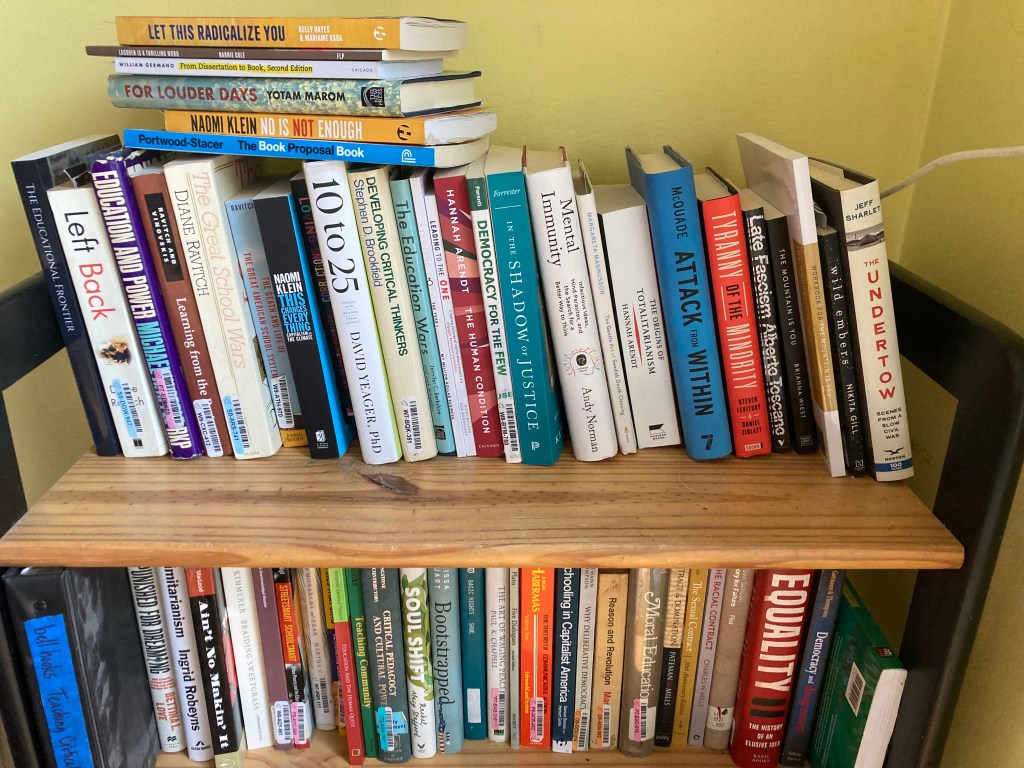
I had such high hopes for what I was going to accomplish once I finished my doctoral degree. So much free time! No papers due! No more worrying that everyone thinks I’m so far behind, or not capable enough to do the thing! (That last one was mainly in my head and is still kinda there). I have included a photo of the 37 books I purchased as “for later” reading during my exams and dissertation writing, plus a few I have bought since. No longer on the 1,000 pages a week treadmill I can read whatever I want, which turns out is mainly things that are closely related to what I studied for my PhD but did not have the time to get to. Or trails unexplored for my dissertation because it turns out you have to put on some serious academic horse blinders to stay focused on a very small portion of the problem in order to finish. Yes, these are all non-fiction. I have a fiction book my son loaned me but it feels like a foreign language to me now. No citations! Egads!
I figured I would take a week off of reading and writing, but it seems to have stretched out past a month. The last stretch of finalizing my paper literally a day before I graduated was pretty stressful and I had read and rejected more literature than most people read in a year, read and kept more than many read in a lifetime. Finishing out the school year at my teaching job while packing my entire art classroom for a building move did not help with my mental spoon capacity either. But, one unforeseen problem was actually the findings of my dissertation research. I completed a comparative normative analysis of two educational philosophies that form the foundation of modern education. I’m sure many people involved in education in any way are familiar with John Dewey and his Progressive Educational Theory. Not many people, including those teaching higher education, are familiar with David Snedden, but they do know his Administrative Progressive Educational Theory because that is the blueprint for everything we continue to do in education. (funny side note to prove my point – I just had to add Snedden to the dictionary as I typed this).
My research was analyzing one book each from these authors using Martha Nussbaum’s Capabilities Approach Theory to determine if their beliefs on the best policies and practices of public education were just and promoted democracy for unique individuals, and I did go into the research with some expectations. I assumed Dewey would be just and democratic, particularly since his book was titled Democracy and Education (1916). But, also because Nussbaum cited his theories quite often and their concepts of the need to focus on the humanities in schooling aligned consistently. I also had an assumption about Snedden, mainly that he would promote democracy and justice and critical thinking and creativity for the white collar, wealthier student populations and suppress it for the blue color and lower class students. Boy, was I wrong. His book Sociological Determination of Objectives in Education (1921) spoke of public education as vocational for everyone. He pushed back on others complaining about separate vocational schools for students who would most likely work in the factories, stating that we do the same for students who are likely to be doctors and lawyers, focusing their education on what they will need for their future jobs through pre-med and pre-law tracks in high schools. Why not adopt a pre-factory model so that students can join the assembly line ready to work on day one?
The problem with all of that might not jump out at you if you weren’t neck high in a pile of books, but one day it knocked me off my feet. I knew that deciding what type of education a student gets starting at the age of 12 based on their family income level, the occupations of their parents, and the available jobs in their neighborhood was unjust and undemocratic for the lower end of the income scale. The practice of social control through education (his oft stated plan to use public education. to keep each generation in the same socio-economic position held by their parents to maintain the status quo) ensured that the factory owners had well-trained employees without the expenditure of training them and also ensured that none of the white collar families had to worry about competing with poor students with potential. But wait. The white collar families are also held in their track, never being allowed to explore an alternative interest. Never encouraged to develop beyond their class and rank. Even the sons of doctors and lawyers were considered future workers instead of individuals with free will and creative individuality.
So here I am, realizing that the divide is not between blue collar and white collar, but between public schools and elite private schools. The 99% who go to public and charter and even Catholic schools, and the 1% who attend the elite academies of presidents and senators and factory owners. The difference between being trained to fit into an existing mold and being educated to be a mold maker with the wealth to back up any stumbles along the way. So, as I attempt to motivate myself into reading again (and getting to the house projects I ignored for the last 5 years), I hope to also explore this vast divide and how it affects educational policy and practices, who it harms and who it benefits, and why it is vital for justice and democracy that we dismantle the biased philosophies of education that perpetuate wealth and income inequality and suppress the personal freedoms of the majority of the population. As we rank schools based on test scores, and consistently praise the suburban schools for their high scores, we really need to stop and take a look at what we are scoring and whether or not it is praiseworthy. Being the best at an unjust and undemocratic education really isn’t a flex. Hopefully, by looking at how we got here we can begin the process of dismantling the system, replacing it with something that treats every individual as valuable and worthy of great things.


Leave a Reply